Canada’s #2 Economic Driver and Why We’re Fighting to Protect It
Advocacy Bulletin – August 21, 2025
Canada's Unsung Economic Heavyweight
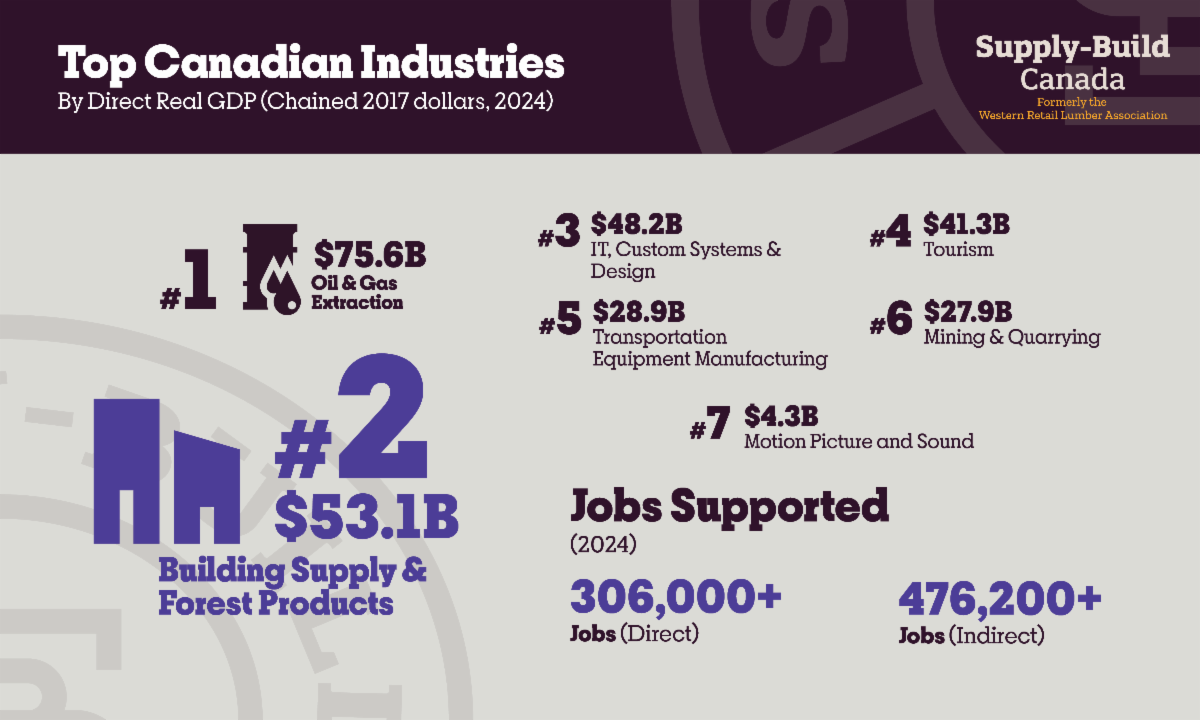
When Canadians talk about economic heavyweights, we often hear about oil, gas, agriculture, or automotive. But the latest numbers tell a different story — our Building Supply industry now ranks #2 in the country for GDP, ahead of mining, automotive, IT, and tourism.
In 2024 alone, building supply dealers and wholesalers generated $26B in direct GDP and supported 306,000 direct and 476,200 indirect jobs in every corner of the country. That’s one in every 26 business sector jobs in Canada — and our growth has outpaced most major industries.
And this isn’t just a Canadian story. Our sector is a critical link in the Canada–U.S. softwood lumber trade, which sustains U.S. housing affordability and stability. But rising tariffs and duties threaten to push up construction costs by billions, cut profit margins, and put jobs at risk on both sides of the border.
Bottom line: Protecting our industry means protecting housing affordability, jobs, and economic stability - here and abroad.
The Building Supply Industry: A $53.1B Economic Powerhouse
Our latest Economic Impact Study, prepared by Jupia Consultants for Supply-Build Canada, reveals the true scale of our industry’s contribution — and why advocacy matters now more than ever.
KEY 2024 FINDINGS
- $45.8B in retail sales from building supply dealers
- $140.7B in wholesale sales
- $61.7B GDP boost combined from retail and wholesale
- 476,200+ jobs supported directly and indirectly
- $11.2B in tax revenue from operations (excluding sales taxes)
When you add Canada’s forest products sector to the mix, our combined GDP contribution reaches $53.1B in real GDP — outpacing transportation equipment manufacturing, mining, and tourism.
Download the Impact Comparison Report HERE
Outpacing Automotive, Mining and Tourism
We’re ahead of transportation equipment manufacturing ($28.9B), mining ($27.9B), and tourism ($41.3B) — fueling growth in every province and territory. From rural towns to major cities, building supply industry are creating jobs, driving investment, and strengthening communities at a scale few sectors can match.
Source: Jupia report
Download the Impact Comparison Report HERE
Why This Matters Beyond Canada's Borders
Impact of Elevated U.S. Duties
The Canada–U.S. softwood lumber trade is a cornerstone of housing affordability and industry stability in both countries.
Key Canada – U.S. Trade Facts
- Canadian imports of softwood lumber = 25% of total U.S. consumption and 5% of construction costs
- Increasing combined duties from 14.5% to 34.5% = +$6,000 per U.S. single-family home (+$23.4B total construction costs)
- Removing current duties = -$4,400 per home
- Adding Section 232 tariffs (25%) would push total duties to 59.5%, adding +$13,500 to home costs
- U.S. sawmills face labor shortages and cannot replace Canadian supply
- Average U.S. homebuilder margin: 11% — could drop up to 3.2 points with tariffs, risking jobs and projects
The World Trade Organization has already ruled U.S. countervailing duties breached global trade rules — this fight is about fair trade as much as economics.
Source: High Peak Strategy (HPS), July 2025
How You can Get Involved
Advocacy works best when our entire industry has a seat at the table. Share your priorities with us — let us know your current points of interest or any industry issues you want addressed.
You can also connect with your local committees for government discussions and participate in roundtables, surveys, and meetings to ensure your voice is heard.
Ready to get involved? Email us at lkovach@supplybuild.ca and we’ll connect you with the right people and opportunities.
Liz Kovach
President
Supply-Build Canada